The Same Subject, A Different Experience
One of the things I enjoy about film photography is that it encourages me to revisit places. Digital often pushes me to move on once I've got the shot, but film has a habit of making me wonder what the same scene might look like with a different emulsion, a different lens, or simply on another day.
This old tree stump was one of those subjects.
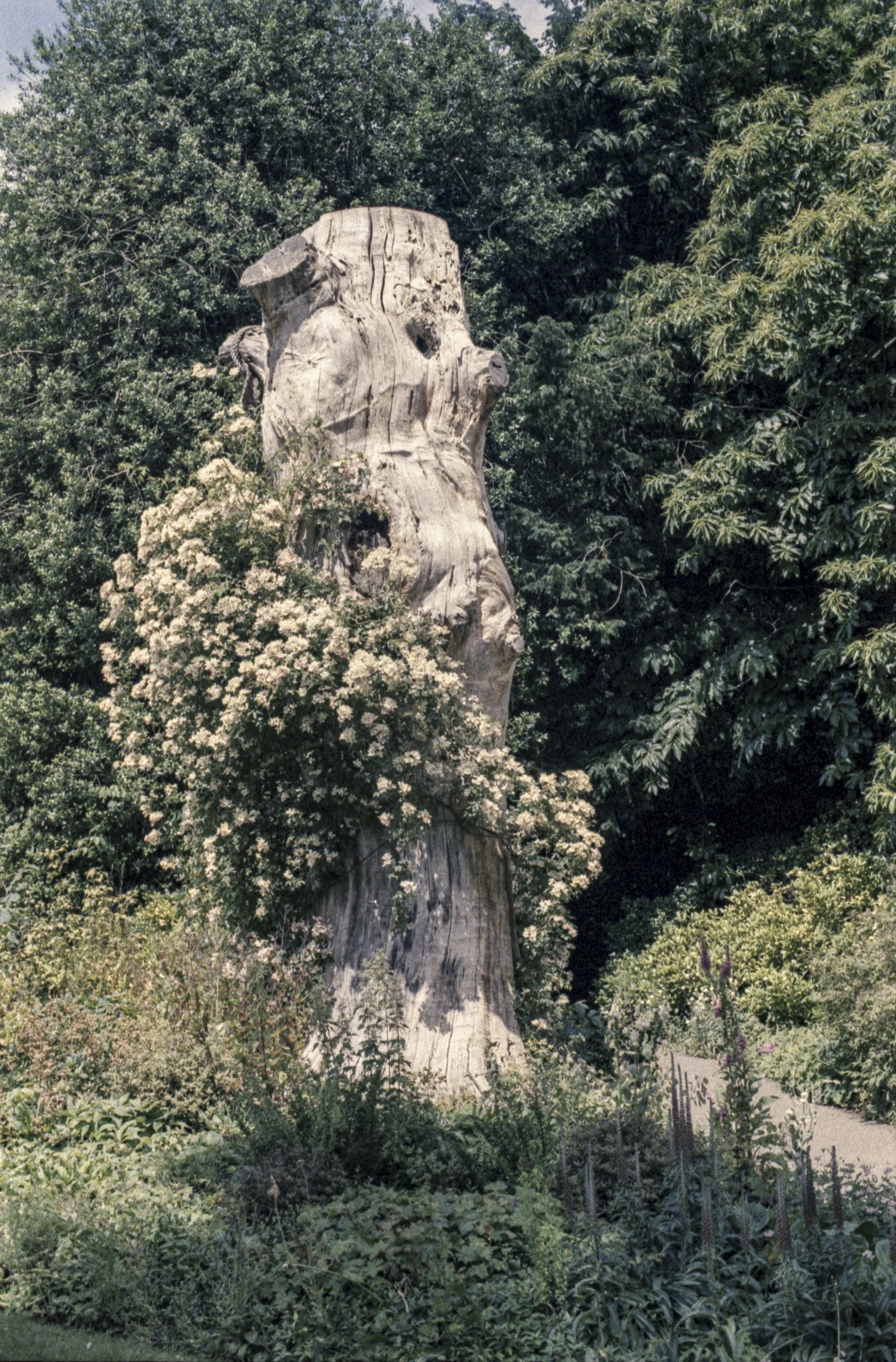
I'd photographed it on a roll of Glow 400 during a wander around the gardens. It wasn't just the stump itself that caught my eye, but the way it had become part of the garden rather than simply sitting in it. The climbing flowers had almost consumed it, softening what must once have been a substantial tree. It had become a feature rather than a relic, and the contrast between the weathered timber and the fresh summer growth made it an obvious photograph.
A few weeks later I found myself back in the same gardens, this time with Ilford SFX 200 loaded into my Olympus OM-1. I'd also packed an R72 infrared filter, intending to make the most of the bright summer foliage. As I walked towards the tree, it occurred to me that it would make an interesting comparison. Not so much to compare the films themselves, but to compare my experience of making the photographs.
The camera and lens hadn't changed. The subject hadn't really changed either. Everything else had.
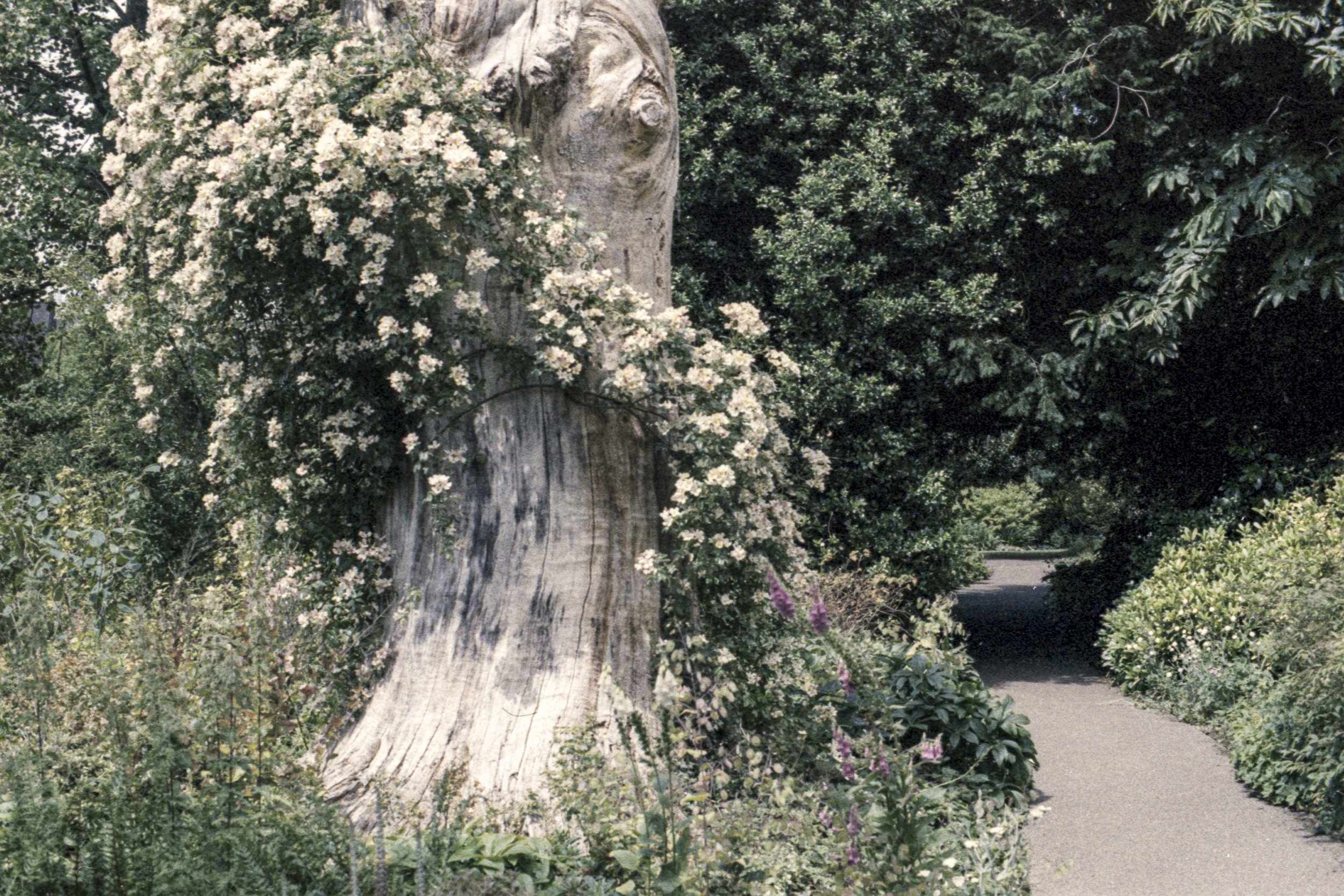
The first two photographs were taken on Glow 400 using my Zuiko 24mm lens. It's probably one of my favourite focal lengths for this sort of scene because it gives just enough width to include the surroundings without making the subject feel lost. The tree remains the focal point, but you can still appreciate the winding paths, the borders and the garden behind.
I don't remember spending particularly long making either photograph. I wandered around for a few minutes, looked at the different angles and settled on two compositions that appealed to me. One placed the tree almost centrally, standing proudly amongst the surrounding planting. The other shifted slightly to include more of the path disappearing behind it, giving the image a little more depth and inviting the eye to explore beyond the obvious subject.
That's one of the pleasures of colour negative film. Although I never shoot carelessly, it allows me to work instinctively. Meter the scene, focus, think about the composition for a moment and release the shutter. If I decide to move a few feet to the left or crouch a little lower, it's no hardship. The process feels natural and unhurried.
Glow 400 suited the scene beautifully. It rendered the greens without becoming over-saturated, while the cream flowers retained plenty of detail against the darker foliage. The colours are gentle rather than dramatic, which somehow felt right for such a peaceful scene.
When I developed, scanned and edited the negatives, I was pleased with both images. They reminded me exactly how the garden had felt that afternoon.
The infrared photograph was an entirely different proposition.
If you've never used an R72 filter, it's worth knowing that once it's fitted to the front of the lens, you can see virtually nothing through the viewfinder. It's almost like putting the lens cap back on. That means everything has to be done beforehand. Composition first, focus second, then fit the filter and make the exposure.
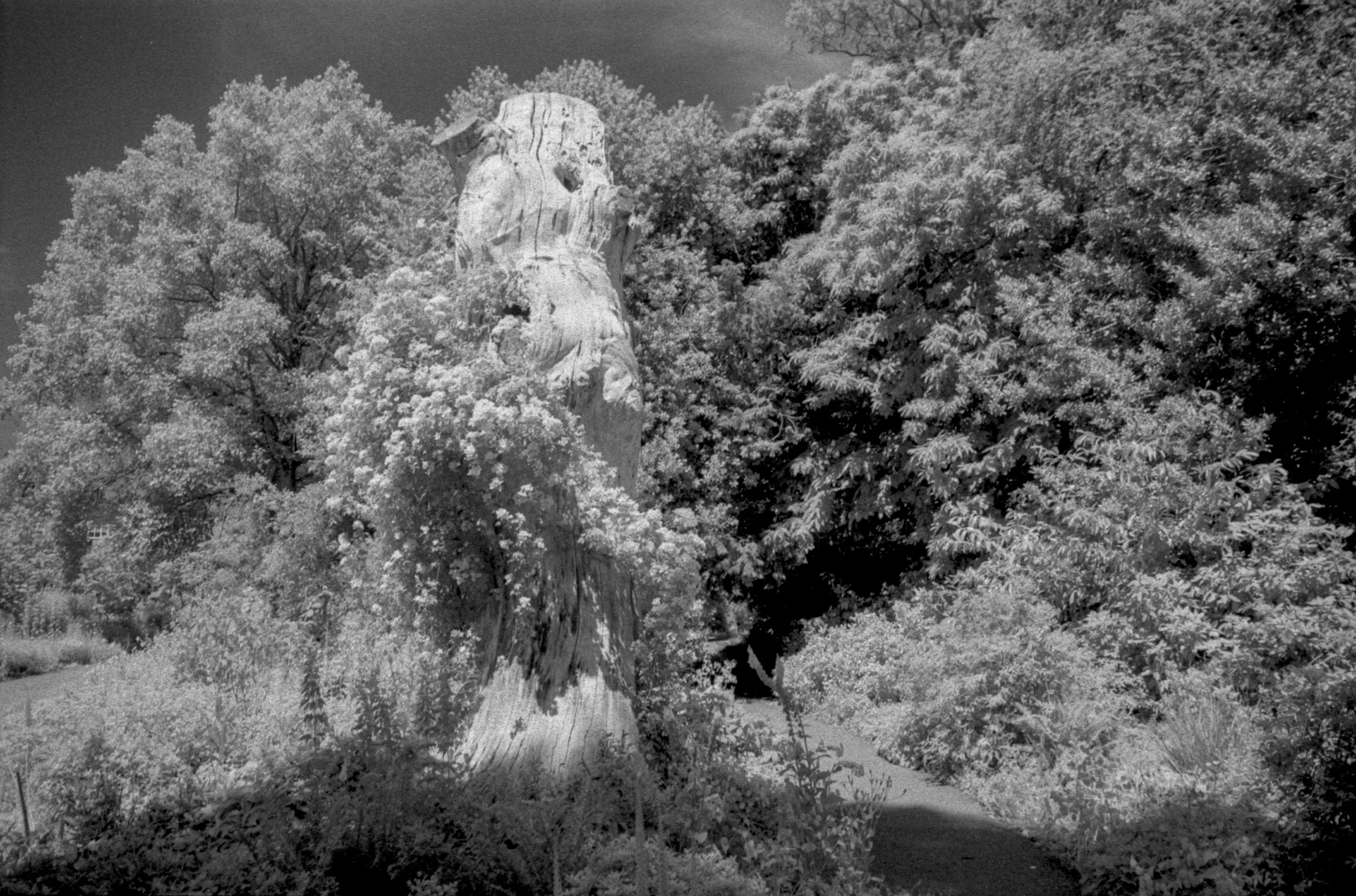
I'd rated the SFX at ISO 12, which meant considerably longer shutter speeds than the Glow 400 photographs. Normally out would come the tripod, and everything slows down,but on this occasion, it was bright enough and my lens was wide enough to shoot handheld - albeit at 1/30 of a second!
I quite enjoy holding my breath and trying to keep as still as possible white I released the shuter.
There's no rushing an infrared photograph. Every frame asks you to stop for a minute and think about what you're doing. Have I focused properly? Have I remembered to compensate for the filter? Did I move too much and spoil the exposure?
It's a very different frame of mind to wandering around with a roll of colour negative film.
Of course, at that point you still have very little idea what the finished photograph will actually look like.
That's one of the things I love about infrared.
You know the theory. Healthy foliage reflects infrared light, so leaves become bright while skies darken dramatically. But until the negatives are developed, you're never entirely sure how a particular scene will respond.
When I scanned the film, the difference was immediately obvious.
The climbing flowers had become almost luminous. The surrounding foliage glowed in a way that simply doesn't happen on conventional black and white film, while the old stump appeared even more textured than I remembered. It was recognisably the same scene, but it carried an entirely different atmosphere.
The Glow 400 photographs feel familiar because they record the garden much as I saw it.
The SFX photograph records something I couldn't see at all.
I find that rather fascinating.
Photography is often described as recording reality, but film reminds us that there isn't just one reality. Different films interpret light differently. Colour negative film, slide film, panchromatic, orthochromatic, infrared, they're all showing us the same world through slightly different eyes.
That's why I don't really think of infrared as a special effect.
It's simply another way of seeing.
Looking back at the three photographs together, I realised that the biggest difference wasn't actually in the finished images. It was in me.
The Glow 400 photographs were made almost instinctively. I was responding to what I saw, moving around until the composition felt balanced and pressing the shutter when it looked right.
The infrared photograph demanded far more concentration. It forced me to slow down, not because I wanted to be artistic, but because the process left me no choice. Ironically, that slower pace probably made me notice more. I spent longer studying the tree, the surrounding foliage and the direction of the light than I had on my earlier visit.
It's easy to think of limitations as inconveniences, but sometimes they're exactly what make photography enjoyable.
Modern cameras are astonishingly capable. They focus almost instantly, meter perfectly and allow hundreds of exposures without a second thought. They're remarkable tools, but occasionally they make everything feel a little too easy.
The OM-1, a manual focus lens, a roll of film and an infrared filter ask a little more of me. Not enough to become frustrating, but enough that I feel involved in every photograph.
Perhaps that's why I keep shooting film.
It isn't because I'm chasing nostalgia, and it certainly isn't because I think it's better than digital. They're simply different experiences.
The same can be said of these three photographs.
If someone asked me which one I preferred, I honestly couldn't answer. The Glow 400 images remind me of a warm afternoon wandering through the gardens with no real agenda beyond enjoying the walk. The infrared photograph reminds me of slowing down, thinking about the process and wondering whether I'd got the exposure anywhere near right.
They're photographs of the same tree, taken with the same camera and the same lens.
But they represent two completely different afternoons behind the viewfinder.
And perhaps that's the real lesson.
Sometimes changing the film doesn't just change the photograph.
It changes the photographer too.